Every AI conversation seems to boil down to the same question: which jobs survive, and which don't.
But, the bigger story isn't jobs disappearing—it's how the jobs will evolve.
On September 23, join us at the Toronto People Analytics Group as Jin Yan from Revelio Labs (Our event Sponsor) breaks down what's actually happening at the activity level: which tasks AI is already reshaping, and why job titles are the wrong lens for workforce strategy.
This will be a live event in Toronto and the spaces are limited.
It rained this weekend in Toronto and though some people like the rain, my dog and I absolutely hate it. The poor guy can't even go do his business outside when it is wet.
Yes, there is a point.
You see, we CAN predict that it will rain tomorrow with a reasonable degree of accuracy (despite everyone complaining about meteorologists on the TV screen).
Your weather app can even estimate the probability of rain within your location at an exact time.
The trick, however, is that the rain doesn't care.
The rain doesn’t care.
Clouds don’t look at your weather app, panic, and decide to dump their water vapor over a neighboring city instead. The weather is a system that observes physical laws without observing you. Or even knowing you exist.
Now contrast that with the stock market.
If a reputable analyst or investor, say Warren Buffet, predicts that a tech stock will crash tomorrow, investors don't just sit on their hands. They sell. The collective response to the prediction causes the stock to plummet.
The prediction didn't just forecast reality; it created it.
In his book Sapiens, Yuval Noah Harari makes a sharp distinction between these two phenomena:
First-Order Chaos: A system that does not react to predictions made about it. (The weather)
Second-Order Chaos: A system that actively reacts to predictions made about it. (Financial markets, politics, human behavior)
In data science, this is often called performative prediction.
And it applies to analytics too!
I don't quite know why exactly, but most workforce models are built on the assumption that the organization is a First-Order system. We act like meteorologists tracking storm patterns.
Except we aren't predicting rain. We’re predicting people.
And people react.
So, let's take a look at two cases.
The Global Talent
Y'all know how much I love macroeconomics.
Think about what happens at a macro level in Talent Acquisition.
A workforce planning model projects a critical shortage of AI engineers over the next three years. The report gets published.
What happens next?
Companies react: They aggressively bump up compensation, expand remote hiring, and pour millions into internal upskilling for their engineers and data scientists. .
Education reacts: Universities launch specialized master’s programs to capture student demand and embed AI across all curriculum. Students rush to graduate with an AI engineering degree.
Workers react: Mid-level software engineers notice the salary spikes and retrain on weekends.
Fast forward three years. The severe talent shortage never materializes.
Was the original model wrong?
Not necessarily. The prediction triggered a cascade of individual and institutional decisions that actively dismantled the shortage.
The prediction was self-defeating.
Conversely, think about the opposite risk: predicting a surplus.
Companies freeze hiring, schools pull funding, and candidates pivot away from a profession. Three years later, you face a self-fulfilled talent crunch—driven almost entirely by the industry acting on the initial forecast.
Sometimes Retention Models Intervene
Now let's bring this down to an organizational level.
Suppose your attrition model flags an employee—let's call him Alex—as a high flight risk with an 85% probability of leaving in the next six months.
The system alerts Alex’s manager.
The manager, wanting to keep a valuable employee, takes immediate action:
Schedules a career mapping session
Adjusts Alex's compensation package by 10%
Reallocates a frustrating project to someone else
Six months pass. Alex stays and is happier than ever.
So, here’s the question:
Was the model wrong?
If you evaluate this through standard machine learning metrics, that output gets classified as a false positive. The model predicted a departure that didn't happen. In a traditional dataset, that looks like noise.
In reality, the model was completely accurate.
It was so accurate that it prompted a successful intervention that rendered its own prediction false.
That’s a very different problem.
The Dark Side of the Paradox
The inverse scenario is where People Analytics teams need to be especially cautious.
What happens when an algorithm marks an employee as a flight risk, but instead of intervening positively, the manager subtly checks out?
Believing the employee is "already gone," the manager stops assigning them high-visibility projects, skips career development conversations, or passes them over for a bonus.
Feeling sidelined, the employee starts updating their resume and leaves.
The model predicted they would leave. They left.
Mathematically, your model logged a true positive. The accuracy score looks great on paper.
In practice, the prediction functioned as an unintended intervention that nudged a disengaged employee out the door.
The model didn't predict the future—it accelerated it.
What This Means for People Analytics
If human systems react to predictions, then People Analytics isn't just a passive observation tool. It’s an active participant in the organizational ecosystem.
Once you accept that predictions are interventions, a few core principles emerge for analytics leaders:
1. Accuracy isn't the only metric that matters
If a retention model’s predictions lead to effective interventions, its historical precision score should degrade over time. If your "flight risk" employees keep leaving at the exact rate predicted despite manager alerts, your analytics aren't failing—the interventions are.
2. Bad training data
When managers intervene based on algorithmic risk scores, they alter the underlying dataset. If high-risk employees are constantly saved through retention bonuses, future models trained on that data might misinterpret the original risk factors. So, you are kind of trying to bend the reality to the curve
3. Categorization changes behavior
The moment employees or managers discover how an algorithm categorizes them (whether as "high potential," "flight risk," or "disengaged"), their behavior shifts. Transparency is necessary, but you have to anticipate the behavioral reflexivity that follows.
Observing vs. Shaping
Data teams love to imagine themselves standing behind a one-way mirror, quietly observing workforce dynamics like scientists in a lab.
But in human organizations, the mirror is always two-way.
The goal of People Analytics shouldn't be to build an infallible crystal ball that passively foretells the future. The real goal is to generate insights that prompt intelligent human interventions—even if those interventions ultimately prove the original prediction wrong.
Are your models simply trying to guess where the workforce is going?
Are you assuming that you are predicting rain?
If so, check your assumptions.
K
Whenever you’re ready, there are 2 ways I can help you:
#1
If you’re still looking to get started in People Analytics, I recommend starting with my affordable course:
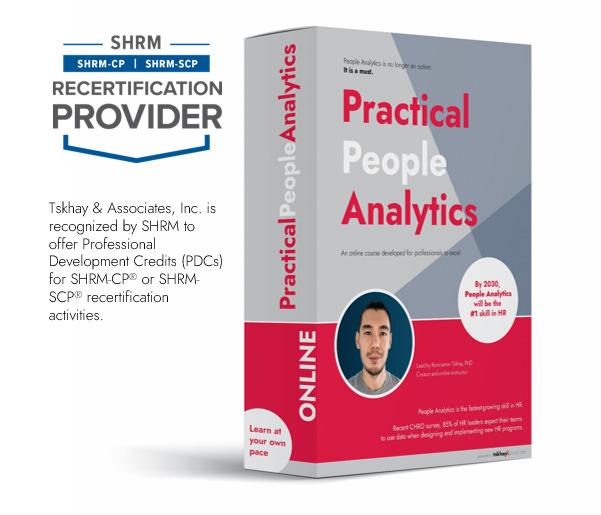
Practical People Analytics: Build data-driven HR programs to 10x your professional effectiveness, business impact, and career. This comprehensive course will teach you everything from building an HR dashboard for business results to driving growth through more advanced analytics (i.e., regression). Join your peers today!
#2
If you are looking for support in your human capital programs, such as engagement, retention, and compensation & benefits, and want to take a more data-driven approach, contact me at Tskhay & Associates for consulting services. Or simply reply to this email!
by Konstantin Tskhay October 7th The Great Lock-In: Why 90% Retention Might Be a Warning Sign ↓ Want to go deeper?This is one of the concepts we explore in the People Analytics course, where we go from theory to actually applying these ideas to real workforce problems. Learn more about the People Analytics course → Hi Friends, Retention numbers across the board are looking better than they have in five years. If you look at your company’s HR dashboard today, voluntary turnover has likely...
by Konstantin Tskhay September 30th Let's Rethink Your Retention Targets ↓ Want to go deeper?This is one of the concepts we explore in the People Analytics course, where we go from theory to actually applying these ideas to real workforce problems. Learn more about the People Analytics course → Hi Friends, I was asked to be a reference recently for a colleague. And I am always happy to do so, considering we worked together and I know you are actually good. But, context is important. When I...
by Konstantin Tskhay September 23rd What AI Is Doing to Analytical Judgment ↓ Want to go deeper?This is one of the concepts we explore in the People Analytics course, where we go from theory to actually applying these ideas to real workforce problems. Learn more about the People Analytics course → Hi Friends,, You have seen this before. Your CHRO pings you: "Why did regrettable turnover among mid-terure software engineers jump 4% last quarter?" Before, or maybe even today, the answer would...