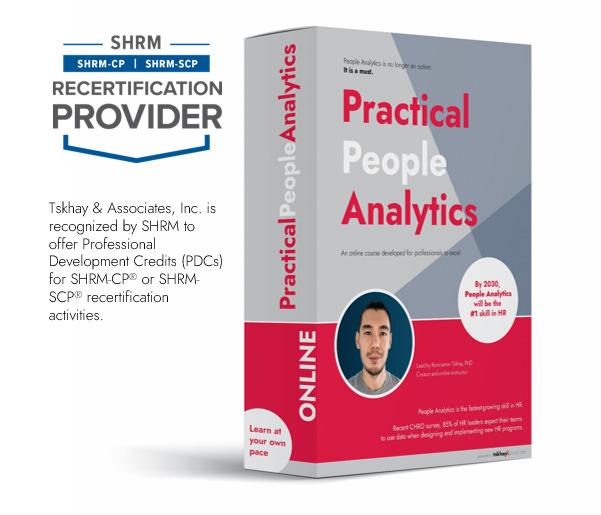
Want to go deeper? This is one of the concepts we explore in the People Analytics course, where we go from theory to actually applying these ideas to real workforce problems.
I was asked to be a reference recently for a colleague. And I am always happy to do so, considering we worked together and I know you are actually good.
But, context is important.
When I was reading the job description for the position, one of the points was about improving retention to 90%.
My first thought was: there is a retention problem.
But my next one was: why is it 90%?
As in... 90% specifically.
And then, it dawned on me:
This is the failure of modern workforce strategy:
We treat retention as a single, target percentage.
We look at an external benchmark (which we don't quite know where they came from), write down "90% target" in a deck, and celebrate when we hit it.
But benchmarking retention a single percentage without context...
Does that make any sense?
Yes, it tells you how many people stayed in seats.
But...
It tells you nothing about whether your business retains what it needs to thrive.
The Macro Data: Execution Is Cheap, Experience Is Bottlenecked
When you analyze macroeconomic labor data—specifically Revelio Labs' dataset of over 75 million job postings—you see a massive shift in what companies actually require.
The noise is clearing out:
Superficial skill requirements go down: The total number of explicitly listed required skills in job postings has dropped by 25%
Experience depth went up quickly: In data and analytical roles, required baseline experience jumped from 2 years to 5 years
Generalists are dropping: Broad software development listings dropped from 25% to 16% of overall tech postings, while listings requiring specialized, domain-specific capabilities surged
What is this data telling us?
AI has made basic output and routine execution a commodity.
Many today can generate code, write a summary, or pull a basic query in seconds. Consequently, employers are stripping away superficial skill "checklists" and demanding real, deep domain context.
Human judgment becomes the primary bottleneck.
The Flaw in Generic Benchmarking
Now, bring that macro reality back to your internal retention reporting.
If your People Analytics team is simply reporting that overall retention shifted from 91% to 90.5%, you are managing noise.
Think about how a doctor evaluates your heart rate.
Your resting average might be 65 bpm. If you walk up a flight of stairs and hit 75 bpm, or relax on a couch and drop to 60 bpm, your doctor doesn't rush you into emergency surgery.
Why?
Because your body operates inside a healthy target band.
Retention is identical.
You don't need a static benchmark number—you need a "Heart Rate Zone" (e.g., 86% to 92%). Here is an AI generated illustration:
When you treat retention as a single static line, two dangerous things can happen:
You panic over normal variance: A 0.4% monthly fluctuation triggers emergency pulse surveys, exit interview deep-dives, and manager training—wasting operational focus over statistical noise
You mask catastrophic skill drain: You hit your 90% retention target, but inside that 90%, your 5+ year domain experts are leaving while legacy generalists stay
Unnaturally high retention (~100%) is often a warning sign of unmanaged underperformance, blocked career pathways for junior talent, and skill stagnation.
On the flip side, breakinand spikes burnout.g below your band bleeds institutional memory
The Four Operational Shifts for HR Leaders
If you want to move beyond misleading benchmark numbers, your analytics strategy must make four immediate adjustments:
Differentiate Skills by Complexity: Stop treating every skill in your HRIS equally. Differentiate between broad operational capabilities (easily augmented by AI) and deep specialized capabilities (requiring years of domain context)
Measure Experience Depth Alongside Skill Tags: Having 500 employees tagged with "Python" or "Data Analysis" means nothing if the business actually requires 5+ years of complex production experience
Map Skill Bundle Shifts: Track how tasks within roles evolve as routine execution gets offloaded to AI
Protect Your Senior Pipeline: Companies want senior experts with 5+ years of experience, but they are automating the junior roles that create them. If you eliminate entry-level execution without building explicit internal pathways to teach judgment, your future talent supply dries up
Moving to Decision-Oriented Analytics
When you sit down with your C-suite, stop presenting slides that say: "Turnover is at 8.5% compared to the industry average of 9.2%."
Frame your analysis differently:
"We are operating inside our healthy retention band of 88–92%. However, within our engineering function, retention of talent with 5+ years of domain experience dropped 6% below our operating zone. We are maintaining overall headcount, but losing critical judgment."
Now, that is a much more interesting (and more importantly, important) workforce planning.
If you're trying to figure out what this should look like inside your organization—moving from rigid HR targets to intelligent workforce performance bands—that's a conversation we can have.
We work with organizations on People Analytics capabilities, workforce planning, and using workforce data to make better decisions.
Whenever you’re ready, there are 2 ways I can help you:
#1
If you’re still looking to get started in People Analytics, I recommend starting with my affordable course:
Practical People Analytics: Build data-driven HR programs to 10x your professional effectiveness, business impact, and career. This comprehensive course will teach you everything from building an HR dashboard for business results to driving growth through more advanced analytics (i.e., regression). Join your peers today!
#2
If you are looking for support in your human capital programs, such as engagement, retention, and compensation & benefits, and want to take a more data-driven approach, contact me at Tskhay & Associates for consulting services. Or simply reply to this email!
by Konstantin Tskhay September 23rd What AI Is Doing to Analytical Judgment ↓ Want to go deeper?This is one of the concepts we explore in the People Analytics course, where we go from theory to actually applying these ideas to real workforce problems. Learn more about the People Analytics course → Hi Friends,, You have seen this before. Your CHRO pings you: "Why did regrettable turnover among mid-terure software engineers jump 4% last quarter?" Before, or maybe even today, the answer would...
by Konstantin Tskhay June 15th Why Your Retention Strategy Needs a "Heart Rate Zone" ↓ Want to go deeper?This is one of the concepts we explore in the People Analytics course, where we go from theory to actually applying these ideas to real workforce problems. Learn more about the People Analytics course → Friends, I started running in Zone 2 now as I am getting ready to be in the boxing fight camp. This is when you are forcing your heart rate to be steady and encourage your body to use fat...
by Konstantin Tskhay September 9th How AI Makes Expertise More Valuable ↓ Want to go deeper?This is one of the concepts we explore in the People Analytics course, where we go from theory to actually applying these ideas to real workforce problems. Learn more about the People Analytics course → Friends, Before we get going... let me do a quick plug! Every AI conversation seems to eventually boil down to the same question: Which jobs survive, and which don't? This weekend, I even met an AI...