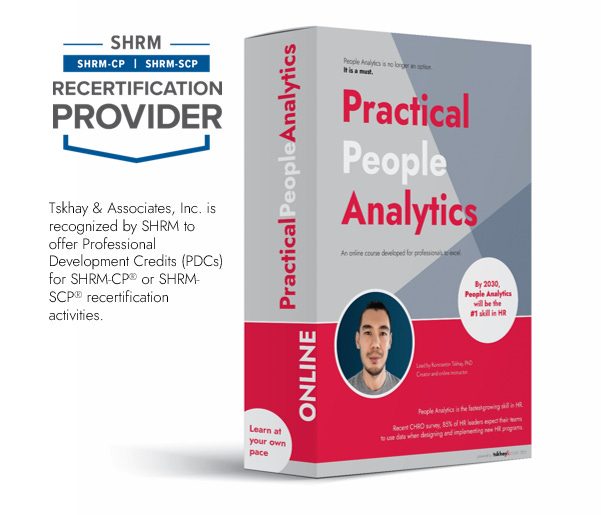
Want to go deeper? This is one of the concepts we explore in the People Analytics course, where we go from theory to actually applying these ideas to real workforce problems.
Over a decade and a bit of being in management and management consulting, I have seen a fair bit of 3-5 year strategies.
And every single time I see them, I am wondering how they will come to life.
And to tell you the truth, the usually don't.
But we still build them.
Strange, right.
Here is a probability concept that is relevant here.
Uncertainty compounds over time.
As the time horizon expands, our confidence should shrink, and our variance bounds should widen.
Instead, many strategy documents I have seen do the exact opposite: they become more specific the farther out they go.
We outline exact job titles for 2030, precise headcount allocations for 2032, and rigid technology implementation timelines for 2035. This creates a comforting illusion of control.
And then, we feel good and push decisions we need to make into the future.
No, long term thinking is not a problem.
I think the real trouble is with a miscalibration of the confidence to the forecast.
What the Science of Prediction Actually Tells Us
In Superforecasting: The Art and Science of Prediction, Philip Tetlock and Dan Gardner detail findings from the Good Judgment Project—a massive multi-year forecasting tournament sponsored by US intelligence agencies.
One of the most striking findings regarding forecasting horizons showed that regular forecasters attempting to predict events 100 days out performed at a certain level of accuracy, whereas elite "Superforecasters" could project 300 days into the future with that same level of accuracy.
Notice what that data actually means:
Even for the top 2% of calibrated forecasters on earth, useful predictive accuracy is measured in months, not decades. Beyond a 12-to-18-month window, signal rapidly decays into noise.
Uncertainty is non-linear.
Technological shifts, interest rate swings, competitive moves, regulatory changes, and AI innovations compound upon one another.
And we are not even talking about the dark swans.
When organizations build 5-year point-estimate plans, they are treating a complex, chaotic system as if it were a simple deterministic machine.
Matching the Tool to the Time Horizon
The goal is not to give up on long-term strategy.
The goal is to become intellectually honest about uncertainty by matching our analytical tools to our time horizons.
And then calibrate the strategy to time.
1. The Proximal Future (0–12 Months): Deterministic Forecasting
In the short term, historical data, leading operational indicators, and probabilistic regression models work well. You can forecast attrition, quarterly hiring demand, and near-term productivity spikes with tight confidence intervals.
2. The Strategic Middle (1–3 Years): Range-Based Sensitivity
In this window, point estimates fail. Strategy should shift from single-number targets to sensitivity analysis, explicit variance bounds, and expected-value calculations across 2–3 plausible trajectories.
3. The Distant Future (3–10 Years): Scenario Planning & Optionality
Beyond three years, standard forecasting models break down.
Here, your primary tool must be scenario planning. You are not predicting what will happen; you are building organizational capability to survive and thrive across multiple distinct futures.
Let's apply this to HR
Workforce Demand Planning:
Traditional Approach: "We will need exactly 420 machine learning engineers in 2029"
Strategic Approach: High-confidence probabilistic forecasting for the next 3 quarters. For 2029, construct three demand scenarios based on technology automation rates and model the variance. As you get more data, update the model.
Skills Architecture:
Traditional Approach: Mapping out a static list of micro-skills required 7 years from now.
Strategic Approach: Identify near-term skill deficits via current workflow assessment. For the distant horizon, invest in foundational meta-capabilities (learning ability, problem-solving, cross-functional collaboration) that hold value across every scenario.
AI and Job Redesign:
Traditional Approach: Predicting precisely which 30% of jobs will be eliminated by AI in 5 years.
Strategic Approach: Track task-level automation metrics today. Build 5-year scenarios around task unbundling, role re-synthesis, and span-of-control shifts, establishing clear trigger points to indicate which future is materializing.
Talent Capital Allocation:
Traditional Approach: Locking in rigid 5-year multi-million dollar recruiting contracts or fixed multi-year hiring commitments.
Strategic Approach: Purchase strategic optionality. Maintain a mix of core permanent talent, flexible contingent capability, and internal mobility channels that can be reallocated dynamically. Sometimes, it is worth to pay for flexibility.
Bayesian Updating
No institutional investor builds a 10-year discounted cash flow model, locks it in a vault, and refuses to touch it when interest rates shift or revenue growth slows.
Capital allocators update their models continuously as incoming data alters asset valuations.
Workforce strategy should operate under the same discipline.
Think of strategy as a system of continuous Bayesian belief updating:
You establish a baseline prior (your initial scenario)
You track leading indicators in labor markets and internal performance
As new evidence arrives, you update your probabilities and reallocate human capital accordingly
The goal of long-term workforce strategy is not to predict 2035 with exact precision.
It is to build an organization that senses fast enough when its initial assumptions about 2035 are wrong.
K
Whenever you’re ready, there are 2 ways I can help you:
#1
If you’re still looking to get started in People Analytics, I recommend starting with my affordable course:
Practical People Analytics: Build data-driven HR programs to 10x your professional effectiveness, business impact, and career. This comprehensive course will teach you everything from building an HR dashboard for business results to driving growth through more advanced analytics (i.e., regression). Join your peers today!
#2
If you are looking for support in your human capital programs, such as engagement, retention, and compensation & benefits, and want to take a more data-driven approach, contact me at Tskhay & Associates for consulting services. Or simply reply to this email!
by Konstantin Tskhay October 14th Forecasting for Value ↓ Want to go deeper?This is one of the concepts we explore in the People Analytics course, where we go from theory to actually applying these ideas to real workforce problems. Learn more about the People Analytics course → Hi Friends, As I speak with people analytics teams, I often notice that many off them get very much into the weeds and details. True, they are data professionals, but it is difficult (in my opinion) to be an effective...
by Konstantin Tskhay October 7th The Great Lock-In: Why 90% Retention Might Be a Warning Sign ↓ Want to go deeper?This is one of the concepts we explore in the People Analytics course, where we go from theory to actually applying these ideas to real workforce problems. Learn more about the People Analytics course → Hi Friends, Retention numbers across the board are looking better than they have in five years. If you look at your company’s HR dashboard today, voluntary turnover has likely...
by Konstantin Tskhay September 30th Let's Rethink Your Retention Targets ↓ Want to go deeper?This is one of the concepts we explore in the People Analytics course, where we go from theory to actually applying these ideas to real workforce problems. Learn more about the People Analytics course → Hi Friends, I was asked to be a reference recently for a colleague. And I am always happy to do so, considering we worked together and I know you are actually good. But, context is important. When I...