The State of People Analytics 2026: My Biggest Takeaways
↓
Hi, Friends,
Over the last 5 years or so, I have served on the HR.com's People Analytics Advisory Board. Most recently, we have built out the State of People Analytics 2026 report based on the feedback from many experts including myself about where we are at and what the future holds.
As I was reading through the final version, one thing stood out to me.
We still have not made too much progress in people analytics.
Yes, we got better at collecting data.
Yes, we got better at storing data.
Yet...
We are still no where near reaping the reward and promise of people analytics to its fullest.
Even then, here is where we are at today:
1. Closing the Execution Gap
One statistic immediately caught my attention.
When we were asked which single barrier would unlock the greatest organizational impact if solved, 57% chose the execution gap. In other words, organizations think that they are producing insights, but those insights are not consistently turning into action.
More than that, previously, we observed that data silos was the biggest barrier to getting the organizational impact. However, and perhaps, with new analytics database technologies emerging, this challenge becomes simpler and easier to address. It has dropped only to 29% of the organizations seeing it as a barrier.
What was odd is that the lack of ownership did not emerge as a barrier at only 14%. Well, maybe that is because 90% of my clients either actively have or have resolved the data governance and insight ownership issue.
Even more that, 50% of experts noted that top priority should be closing the execution gap and focusing on the key capability of turning analytics into useful actions. And, between you and I, the challenge here is less about analytics and more about how we communicate those analytics--data storytelling (something a few of my clients have been asking me about).
2. Business Relevance Has Become the New Credibility
Another finding I found interesting was around business relevance.
When experts were asked why People Analytics teams often struggle to participate in operational planning meetings, half said workforce metrics simply aren't connected closely enough to business or financial goals.
That is an important distinction.
For years we've talked about improving reporting.
Maybe the better question is:
Are we reporting on the things the business actually cares about?
Let's use turnover as an example.
Instead of reporting:
Turnover increased by 3%.
Try connecting it to something leaders already understand.
For example:
delayed projects
increased hiring costs
customer experience
productivity
revenue per FTE
The data hasn't changed.
The conversation has.
But, I actually think we are facing a different issue all together here. What I have noticed is that the people analytics functions often are not connected closely enough to the business.
They don't ask the business about what question they have, instead trying to push what they know well forward.
So: Perhaps, before we present the next turnover number at the meeting, we should pause and ask ourselves: people analytics for what?
3. The Role of People Analytics Is Changing
One section of the report really reinforced something I've been seeing with clients--an intentional move to becoming a strategic partner.
High-impact teams aren't measured by how many dashboards they build. Instead, experts described them as teams that:
start with business problems,
participate in leadership discussions,
and measure success by business outcomes
That's a very different operating model and people analytics strategy.
Traditional approach
The analyst waits in the background tinkering with data. A business leader asks for a dashboard. The analytics team builds it. The dashboard gets presented.
Project complete.
Analyst back to tinkering with data.
Strategic approach
The analyst is asking the business leader about their most pressing issues. A business leader says turnover is increasing. The analytics team investigates.
They then identify the drivers. They also recommend actions.
Then they help measure whether those actions worked.
You see the difference. One group is reactive and you are probably not getting much value and ROI on maintaining the analytics team.
Another is strategic, helping you address the issues proactively.
I hope, with an advent of AI, we will see more teams move to a more strategic people analytics function.
4. AI Still Needs Human Judgment
Of course, the report also spent quite a bit of time discussing AI.
And there are a few cases where I think AI will really be more relevant: automation, democratization, and real-time insights.
However, I am skeptical around how quickly can AI truly replace human judgement.
Yes, lots of people are starting to feed data into AI and ask it to find interesting insights and it can find some.
However, in my personal experience, they thing is still making way too many errors, not noticing duplicates, coding data incorrectly, and even running analyses without using proper assumption tests and variance covariance matrices.
That is quite problematic as some models are not made for some types of data.
Hence, the results of these models cannot be trusted.
Believe me: I am super bullish on AI.
However, without proper statistics and analytics background, I would not trust many interpretations that it is making.
Till next time!
K
Whenever you’re ready, there are 2 ways I can help you:
#1
If you’re still looking to get started in People Analytics, I recommend starting with my affordable course:
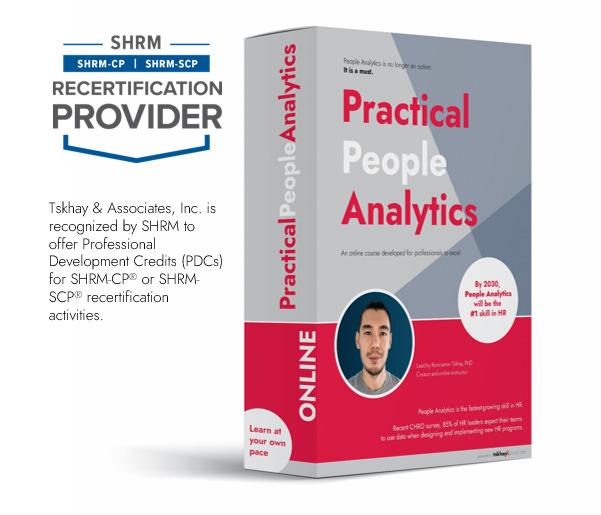
Practical People Analytics: Build data-driven HR programs to 10x your professional effectiveness, business impact, and career. This comprehensive course will teach you everything from building an HR dashboard for business results to driving growth through more advanced analytics (i.e., regression). Join your peers today!
#2
If you are looking for support in your human capital programs, such as engagement, retention, and compensation & benefits, and want to take a more data-driven approach, contact me at Tskhay & Associates for consulting services. Or simply reply to this email!
by Konstantin Tskhay September 23rd What AI Is Doing to Analytical Judgment ↓ Want to go deeper?This is one of the concepts we explore in the People Analytics course, where we go from theory to actually applying these ideas to real workforce problems. Learn more about the People Analytics course → Hi Friends,, You have seen this before. Your CHRO pings you: "Why did regrettable turnover among mid-terure software engineers jump 4% last quarter?" Before, or maybe even today, the answer would...
by Konstantin Tskhay June 15th Why Your Retention Strategy Needs a "Heart Rate Zone" ↓ Want to go deeper?This is one of the concepts we explore in the People Analytics course, where we go from theory to actually applying these ideas to real workforce problems. Learn more about the People Analytics course → Friends, I started running in Zone 2 now as I am getting ready to be in the boxing fight camp. This is when you are forcing your heart rate to be steady and encourage your body to use fat...
by Konstantin Tskhay September 9th How AI Makes Expertise More Valuable ↓ Want to go deeper?This is one of the concepts we explore in the People Analytics course, where we go from theory to actually applying these ideas to real workforce problems. Learn more about the People Analytics course → Friends, Before we get going... let me do a quick plug! Every AI conversation seems to eventually boil down to the same question: Which jobs survive, and which don't? This weekend, I even met an AI...